This sucks!
Quote; "Senior managers at the National Toxicology Program (
NTP) released the preliminary results of their
cell phone radiation study late last week. They were so concerned about the
elevated rates
of two types of cancer among exposed rats that they felt an immediate
public alert was warranted. They considered it unwise to wait for the
results to wend their way into a journal sometime next year. Not
surprisingly, the NTP report generated worldwide media attention.
There were some startling reactions. Both the American Cancer Society
(ACS) and Consumers Reports immediately shelved their long-held,
wait-and-see positions. In a
statement issued soon after the NTP’s press conference,
Otis Brawley,
ACS’ chief medical officer, said the NTP results mark a “paradigm shift
in our understanding of radiation and cancer risk.” He called the NTP
report “good science.”
Consumer Reports said that the new study was “
groundbreaking” and encouraged people to take simple precautions to limit their exposures.
However, much of the mainstream media saw it very differently. This was apparent at last Friday’s
news briefing where the skepticism among reporters was palpable. The
Washington Post ran its story under the headline,
“Do Cell Phones Cause Cancer? Don’t Believe the Hype.”
One question on many people’s minds was why, if cell phones cause
cancer, there hasn’t been an uptick in the incidence of brain tumors in
the American population. For instance,
Gina Kolata, a science reporter at the
New York Times, gave the NTP study zero credibility. In a
short video accompanying the
Times’
news story, Kolata said that there is “overwhelming evidence” that cell
phones do not lead to cancer. “Despite the explosion of cell phone
use,” she said, “it looks like the incidence of brain cancer has
remained pretty much rock steady since 1992.” The “bottom line,” she
concluded, is that, “You can use a cell phone without worrying.”
There’s More Than One Type of Brain Tumor
The issue of whether brain tumor rates are static or rising is more
complicated than Kolata would have us believe. It’s true that the
overall incidence of brain tumors has not been changing much, but a
different picture emerges if one looks, carefully, at the data.
The histogram below helps tell the story. It’s based on brain tumor
data from The Netherlands. The black segment of each column tracks the incidence of
glioblastoma multiforme (GBM),
the most aggressive and deadly type of brain tumors. While the total
incidence of all types of brain tumors in The Netherlands rose at the
rate of only about 0.7% per year, the increase in GBM was about 3.1% per
year —that is, the incidence more than doubled over the period
1989-2010. (Follow the thin red line we superimposed on the histogram to
track the trend.) This is a statistically significant increase. At the
same time, the rate of all the other types of brain tumors went down;
these changes are also significant. The higher incidence of GBMs is
being masked by the lower rates of the other types of brain cancer.
GBMs Are Also Rising in the U.S.
A similar trend is occurring in the U.S., according to a team from
the University of Southern California Medical School in Los Angeles. The
USC researchers looked at the incidence of brain tumors in three “major
cancer registries” over a 15-year period (1992-2006). In a
paper
published in 2012, they reported that GBMs had gone up while the other
types had gone down. The study showed “decreased rates of primary brain
tumors in all sites with the notable exception of increased incidence of
GBM in the frontal lobes, temporal lobes and cerebellum.”
The increase in GBMs in the temporal lobe (the region of the brain
closest to the ear and potentially to a phone) was seen in all three
registries, ranging from approximately 1.3% to 2.3% per year, a finding
that is statistically significant.
Some anecdotal evidence from Denmark also supports a rising incidence of GBMs. Back in 2012, the Danish Cancer Society
reported a spike
in GBMs. The Society quoted a neuro-oncologist at Copenhagen University
Hospital as saying this was a “frightening development.” There wasn’t
much of a follow-up other than the society’s removal of the news
advisory from its website. (See our
“Something Rotten in Denmark.”)
Cell Phones Linked to GBMs
Perhaps, the increasing rate of GBMs seen in the U.S., The
Netherlands and Denmark is due to some unknown factor. But, whatever may
be going on, GBMs are on the rise.
While most cell phone epidemiological studies do not break out the risks for different types of brain tumors,
Lennart Hardell
of Örebro University Hospital in Sweden has done so. “We have
consistently found an increased risk for high-grade glioma, including
the most malignant type, glioblastoma multiforme grade IV [GBM], and use
of wireless phones,” he
told Medscape
earlier this month. Hardell’s epidemiological studies were instrumental
in IARC’s decision to classify RF radiation as a possible carcinogen.
In an e-mail exchange with
Microwave News, Hardell confirmed the Medscape quote. He added that he has also found that, in an
analysis of 1,678, patients with GBMs in Sweden, those who used wireless phones had shorter survival times.
How Big Were the Increases in Tumors in the NTP Study?
Another media skeptic,
Seth Borenstein,
a reporter at the Associated Press, posted a video in which he called
the increase in cancer in the rats “very slight” and therefore the
cancer risk “very small.”
This is in line with the
report
the NTP posted online last week in which it called the incidence of
tumors “low.” But some observers think the cancer rates among the rats
are in fact higher than the NTP is saying.
At the press conference,
Joel Moskowitz
of the University of California, Berkeley, School of Public Health
pointed out that a number of the exposed animals, but none of the
control rats, developed abnormally high cell growth rates —hyperplasia—
in the same type of glial and Schwann cells where tumors developed in
other animals. (An audio recording of the press briefing is available
here.)
Moskowitz calls the hyperplasia cells “precancerous,” as does
John Bucher,
the associate director of the NTP, who released the study on Friday. It
is commonly believed that hyperplasias will likely later turn into
malignant tumors. Moskowitz estimates that while the NTP found tumors in
5.5% of the exposed male rats at the end of the experiment, when those
with hyperplasia are included, the rate goes up to 8.5%. “That’s a
remarkable finding,” he told
Microwave News.
“I totally agree with Joel,” commented
Ron Melnick,
who led the team that designed the NTP study. “He has a valid
argument.” Melnick also pointed out that, “The study had low power and
was more likely to show no effect. The fact that it did makes the
results more compelling.”
If the exposures had continued for longer than two years, the results
may have been clearer. During the study planning phase, Melnick argued
for running the experiment for at least another couple of months. If he
had prevailed, the status of the hyperplasias would have been clearer.
He was overruled.
“It might be that extending the observation until the rats die,
tumors could arise from some of the observed hyperplasias,” said
Fiorella Belpoggi
of the Ramazzini Institute in Bologna, Italy, where she is the director
of research and the head of pathology. “But,” she added, “the NTP
results are indeed sufficient for considering cell phone radiofrequency
radiation as carcinogens.”
Belpoggi and her colleague
Morando Soffritti recently
released
their own large animal study which showed that another type of
non-ionizing radiation, ELF EMFs, can promote cancer. They are also in
the midst of their own large RF animal study, but it has been delayed by
a shortage of funds." Go to:
http://microwavenews.com/news-center/ntp-and-brain-tumor-rates For full article.
Quote; "Effect of radio-frequency radiation from Wi-Fi devices on mercury release from amalgam restorations
Background
Dental amalgam is composed of
approximately 50% elemental mercury. Despite concerns over the toxicity
of mercury, amalgam is still the most widely used restorative material.
Wi-Fi is a rapidly using local area wireless computer networking
technology. To the best of our knowledge, this is the first study that
evaluates the effect of exposure to Wi-Fi signals on mercury release
from amalgam restorations.
Methods
Standard class V cavities were
prepared on the buccal surfaces of 20 non-carious extracted human
premolars. The teeth were randomly divided into 2 groups (n
= 10). The control group was stored in non-environment. The specimens
in the experimental groups were exposed to a radiofrequency radiation
emitted from standard Wi Fi devices at 2.4 GHz for 20 min. The distance
between the Wi-Fi router and samples was 30 cm and the router was
exchanging data with a laptop computer that was placed 20 m away from
the router.
The concentration of mercury
in the artificial saliva in the groups was evaluated by using a
cold-vapor atomic absorption Mercury Analyzer System. The independent t test was used to evaluate any significant differences in mercury release between the two groups.
Results
The mean (±SD) concentration
of mercury in the artificial saliva of the Wi-Fi exposed teeth samples
was 0.056 ± .025 mg/L, while it was only 0.026 ± .008 mg/L in the
non-exposed control samples. This difference was statistically
significant (P =0.009).
Quote; "“The data shows major reorganization of the cloud system… I
consider this as the most singular of all the things that we have found,
because many of us had been thinking the cloud changes might help us
out, by having a strong feedback which is going the other way instead of
amplifying it.” —
climate scientist Veerabhadran Ramanathan
“Our results suggest that radiative forcing by a combination of anthropogenic greenhouse gases and volcanic aerosol has produced observed cloud changes during the past several decades that exert positive feedbacks on the climate system.
We expect that increasing greenhouse gases will cause these cloud
trends to continue in the future, unless offset by unpredictable large
volcanic eruptions.” —
Evidence for Climate Change in the Cloud Satellite Record (emphasis added).
Scientists now have a satellite record of cloud behavior over the past few decades.
What they’ve found is
that, in response to Earth warming, cloud tops are rising even as
clouds are forming at higher altitudes. This traps even more heat at the
Earth’s surface. In addition, storms are moving north toward the poles,
which means more sunlight hits the temperate regions near 40 degrees
latitude both in the Northern and Southern Hemispheres. This northward
movement of storms also causes the Earth to warm more rapidly. In the
past, scientists had hoped that changes in clouds would shelter the
Earth from some of the greenhouse gas warming caused by fossil fuel
emissions. What we are finding now is that the opposite is true. The way
clouds change as the Earth warms appears to be increasing the intensity
of greenhouse gas warming.
Sowing the Clouds With Doubt, Denial and False Hope
Will the impacts of human-caused climate change be as bad or even
worse than we feared? Will the Earth warm as rapidly or more rapidly
than climate models suggest?
These are critical questions. Ones that revolve around the issue of
how sensitive the Earth is to the added heat build-up initiated by a
large and growing pulse of human-emitted greenhouse gasses. One whose
answer will have lasting consequences for all those currently alive
today and for many of the generations to follow. For if the answer to
this question is yes, then we have responded too slowly to what is now a
swiftly worsening global climate crisis (and,
according to a new observational study, that answer appears to be, with growing certainty, YES).
(
A new study
has found that human forced warming drives the storm track toward the
poles. This increases drought risk for places like the US Southwest. It
is also a part of a larger cloud feedback that is found to have caused
the Earth to warm more rapidly. Image source:
LANCE MODIS.)
In relation to these questions is a noted relevant scientific
uncertainty over the behavior of clouds in response to warming.
Mainstream science
has
long produced state of the art climate models showing that changes in
clouds due to Earth’s warming was likely a heat-enhancing (positive)
feedback overall. And paleoclimate studies have tended to support
the kinds of Earth System sensitivity to heat forcing that would result.
But due to the fact that cloud behavior is difficult to model (and
confirm through observation), there was a decent level of uncertainty in
the science over the issue. And it is this seeming gap in our physical
understanding that has spurred a big controversy circulating among
climate change skeptics/deniers and the mainstream scientific community.
On the deniers side are people like Judith Curry, Roy Spencer,
Richard Lindzen, and Anthony Watts (
and their fossil fuel backers)
who have broadly asserted that clouds respond to warming in a way that
alleviates some of the added heat. The group also claimed that the
cooling impact of clouds (negative feedback) was strong enough to reduce
the Earth’s overall sensitivity to human greenhouse gas forcing to
significantly less than the widely accepted 3 C Equilibrium Climate
Sensitivity range (ECS — or about a 3 C warming over an approximate 100
year period for each doubling of CO2, or approximately double that
warming over the long term). On the other side are the mainstream
scientific heavy weights — including notables like
NASA GISS’s Gavin Schmidt and
Michael Mann of Hockey Stick notoriety —
along with a large and growing body of studies producing evidence to support the cloud model essays.
The upshot has produced what could best be called a debate enabled to
sow doubt (climate skeptics/deniers tend to receive funding from fossil
fuel think tanks and other political bodies, which is a marked and
glaring conflict of interest) between actual science and what might well
be characterized as
an intentionally misleading industry PR campaign.
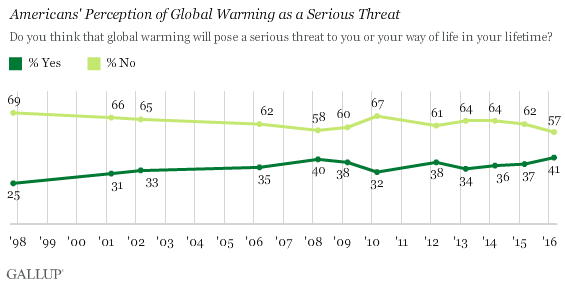
(Climate change is a very serious threat. It threatens the existence
of coastal communities like Miami, Norfolk, and New York City, it’s
putting the US Southwest into an increasingly dangerous drought and
water shortage situation, it’s driving vector driven illnesses like Zika
out of their tropical zones, it’s threatening the stability of global
food supplies, it’s forcing mass migration on a scale worse than warfare
and conflict, and it’s pumping up the intensity of the most extreme
weather events. Despite glaringly obvious trends revealing worsening
climate states, just 41 percent of the American public views climate
change as a serious threat. This is in large part due to confusion sown
by climate change skeptics and deniers. Image source:
Gallup.)
Wrapped up by this doubt-sowing were a number of scientists who
simply seemed to hope that something (even changes in clouds) would give
humankind enough time to make the tough policy choices needed to
respond to human-forced warming. This group included a number of
well-intending individual scientists who simply appeared unwilling to
unequivocally accept the stark implications coming from the model
assessments and from the paleoclimate proxy data.
Unfortunately, uncertain understanding of how clouds respond to
warming has served either as false comfort or fed into yet one more
climate change skeptic/denier based doubt-sowing delaying tactic for
much-needed global policy action on climate change.
High Clouds, Middle Latitude Drying Enhance Human-Forced Warming
Now, a new observational study headed by Joel Norris
has helped to clear up some of this uncertainty. The study used
satellite based observation of cloud behavior over the past 25 years to
confirm that alterations in Earth’s cloud cover is producing an
amplifying feedback to human caused climate change. In other words, the
heat provided by human fossil fuel emissions is forcing the clouds to
respond in ways that warm the Earth even faster.
At issue are two big mechanisms. The first is that warming up the
Earth’s atmosphere is observed to be forcing the storm tracks toward the
poles. This pole-ward movement is resulting in less overall cloud cover
for the middle latitudes. Less cloud cover in this region reduces the
coverage of bright, reflective clouds which, in turn, generates a loss
of Earth reflectivity (albedo). As a result, more of the sun’s rays
enter the Earth’s lower atmosphere in this zone which causes the
atmosphere to heat up.
The second big cloud feedback mechanism was an observed increase in
upper level cloud formation. This is important because high level clouds
act as a blanket, trapping more of the Sun’s heat in the atmosphere.
What the study found was that cloud tops were both rising even as the
number of clouds at higher altitudes was increasing.
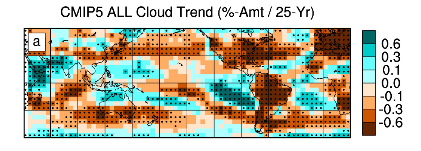
(Higher cloud tops and less cloud cover in the middle latitudes means
that the Earth warms faster due to human greenhouse gas emissions. In
addition, a poleward movement of the storm track facilitates drying
across many continental regions including Brazil, the US Southwest,
Europe, and parts of Africa, Asia, and Australia. Image source:
Evidence for Climate Change in the Cloud Satellite Record.)
This combination resulted in an observed increase in
radiative forcing on the order of 0.39 Watts per meter squared.
That’s about a 12 percent increase above and beyond the base additional
greenhouse gas forcing currently provided by human beings. In other
words, the way clouds respond to human greenhouse gas emissions caused
the world to warm up even faster.
In addition to these changes that add heat to the Earth System, there
is one noted significant knock-on effect. Loss of clouds in the middle
latitudes results in less rainfall for places like the Amazon
Rainforest, the US Southwest, and large parts of Europe, Africa, Asia,
and Australia. In this way, shifting storm tracks are an enabler not
only to amplified global warming, but also to the increasingly prevalent
and severe droughts and wildfires that we are now seeing in many of the
most highly populated parts of the world." Go to:
https://robertscribbler.com/2016/07/15/clouds-of-denial-clear-as-rising-storm-tops-middle-latitude-drying-found-to-speed-global-warming/
For full article.


